How blackjack works: the rules in plain English
Blackjack looks simple: get closer to 21 than the dealer without going over. The details that matter are the order of play, what you can do with a hand, and how winning hands are paid. This guide walks through one full round and explains each rule as it comes up.
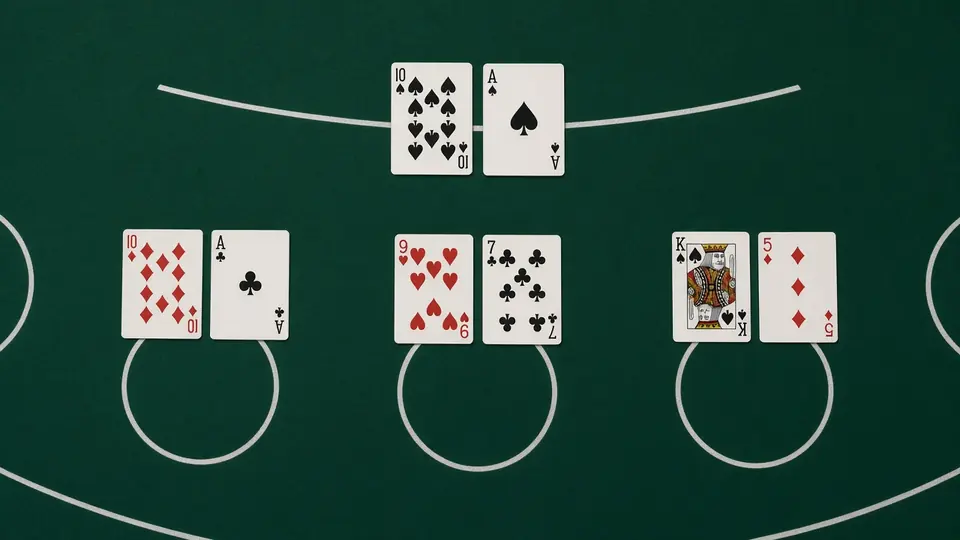
In brief
You win by beating the dealer's total without going over 21. You play first, so a bust loses straight away, and that single fact is where the house edge comes from.
The aim of the game
You are playing against the dealer, not against the other people at the table. You win a round if your hand ends closer to 21 than the dealer's hand, or if the dealer goes over 21 (a "bust") while you have not. If you go over 21 yourself, you lose at once, whatever the dealer holds afterwards.
Cards 2 to 9 count at face value. Tens, jacks, queens and kings all count as 10. An ace counts as either 1 or 11, whichever suits the hand better at that moment. The next guide covers hard and soft hands in more detail.
One round, step by step
- You place a bet. Every table shows a minimum and a maximum.
- Cards are dealt. You get two cards, and the dealer gets two. One dealer card is face up (the "upcard"). On most tables the other is dealt face down, the "hole card". At some European-style tables the dealer's second card is not dealt until you have finished playing, which is covered in European blackjack.
- Blackjack check. If the dealer's upcard is a ten-value card or an ace, many tables check for a dealer blackjack straight away (the "peek"). If the dealer has it, the round ends there.
- You play your hand. You choose from the options below, one hand at a time.
- The dealer plays. The dealer turns over the hole card and then follows fixed rules with no choices: draw on 16 or less, stand on 17 or more. On many tables the dealer also draws on "soft 17" (an ace counted as 11 plus a 6). Whether this happens is one of the rules to read before you sit down.
- Hands are settled. Winners are paid, losers lose their bet, and equal totals are a "push" where your bet is returned.
What you can do with your hand
- Stand: keep your total and end your turn.
- Hit: take another card. You can hit as often as you like until you stand or bust.
- Double down: double your bet, take exactly one more card, then stand. Tables differ on which hands you may double.
- Split: if your two cards have the same value, you can place a second bet equal to the first and play them as two separate hands. The splitting guide explains when this helps.
- Surrender: on tables that offer it, give up half your bet and end the round. See surrender.
- Insurance: a side bet offered when the dealer shows an ace. It is usually a poor bet, as explained in insurance and even money.
How hands are paid
An ordinary win pays 1 to 1: a £10 bet wins £10. A "blackjack" is an ace plus any ten-value card as your first two cards. It beats a normal 21 and pays 3 to 2 on most tables, so a £10 bet wins £15. A blackjack that meets a dealer blackjack is a push.
Some tables pay blackjack at 6 to 5 instead, which would turn that £10 bet's profit into £12. It sounds like a small change, but it is one of the most expensive rule changes in the game. The table rules guide shows how much.
An example hand
You are dealt a 10 and a 6 for a total of 16. The dealer shows a 10. You hit and receive a 4, making 20. You stand. The dealer turns over a 7 for 17, and stands. You have 20 against 17, so you win 1 to 1.
Change one thing: you hit your 16 and receive an 8, making 24. You have bust and lose immediately, even if the dealer would have gone on to bust as well.
Why the dealer has an edge
Blackjack is a near-even contest, but not an even one. You act before the dealer, so if you bust, the dealer never needs to play. Dealer busts only help you on the hands where you survived. Your own choices (hit, stand, double, split) claw most of that back, which is why playing correctly matters so much. Even perfect play leaves a small edge for the house, usually somewhere between a fraction of a percent and about one percent depending on the rules. The next steps are house edge explained and the basic strategy chart.
Quick answers
Can I see the dealer's hole card?
No. On most tables only the dealer's upcard is visible until you have finished playing. The exception is Double Exposure, where both dealer cards are face up and other rules change to compensate.
What is a push?
A push is a tie. If your total equals the dealer's total, your bet is returned and nobody wins or loses.
Is blackjack the same as twenty-one?
They are close relatives. "Twenty-one" and "vingt-et-un" are older names for the same family of games. The history of blackjack tells the story.
Does the number of players change my odds?
Not in any meaningful way. The dealer's cards are drawn from the same shoe, but the order of players does not change your long-run odds.
Keep reading
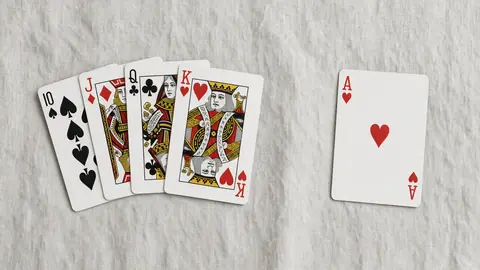 Card values and handsEvery decision in blackjack starts with knowing what your total is and whether your ace can still change.
 House edge explainedThe house edge is the average share of each bet the casino expects to keep over the long run.
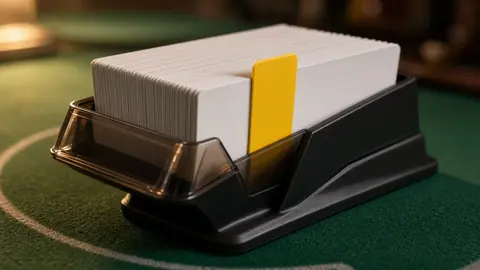 Table rules and decksTwo blackjack tables can look identical and have very different odds.
 Basic strategy chartBasic strategy is the best possible play for every hand against every dealer upcard, for a given set of rules.