Insurance and even money: why basic strategy says no
When the dealer shows an ace, many tables offer insurance. It sounds like a safeguard, but it is a separate bet with a poor price. This guide works through the numbers so you can see why basic strategy never takes it.
In brief
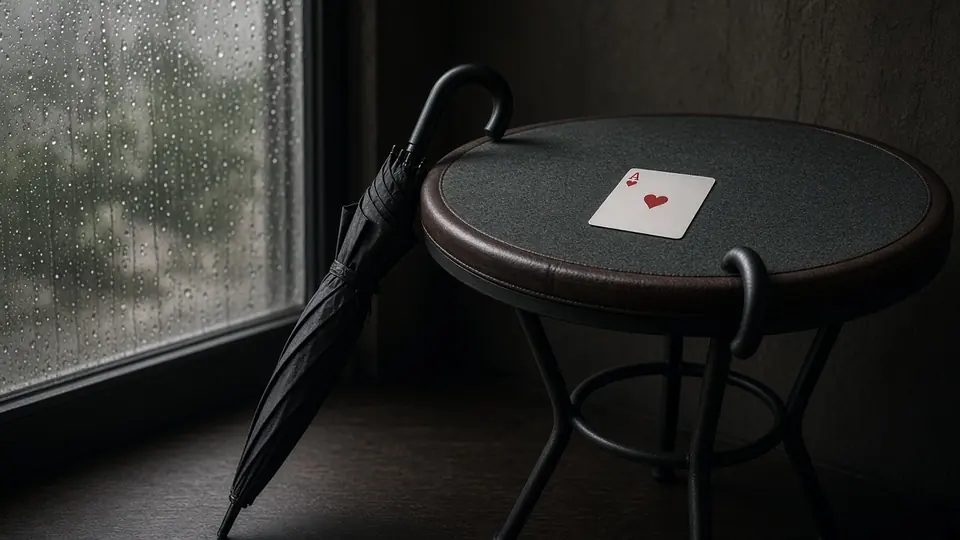
Insurance costs half your bet and pays 2 to 1 if the dealer has blackjack. With ten-value cards making up 4 of 13 ranks, it costs about 7.7% of the side bet on average. Taking even money with a blackjack is the same bet.
How insurance works
When the dealer's upcard is an ace, you are offered insurance. You can place a side bet of up to half your original wager. If the dealer has a blackjack, the insurance pays 2 to 1. Your main hand loses (unless you also have a blackjack), so on a £10 hand you lose £10 and win £10 on a £5 insurance bet. You break even. If the dealer does not have a blackjack, you lose the insurance bet and play on.
The idea is that insurance protects your hand. In reality it is a different bet, and the price is wrong.
Why it loses money
The insurance bet wins if the dealer's hidden card is worth ten. Treat the cards as an endless supply of the thirteen ranks: four of them (10, J, Q, K) count as ten, so the chance is 4 in 13, or about 30.8%.
The bet pays 2 to 1. Betting £1 on insurance:
- Win £2 with probability 4/13.
- Lose £1 with probability 9/13.
Average result: (2 × 4/13) − (1 × 9/13) = (8 − 9)/13 = −1/13 ≈ −7.7% of the insurance stake.
So each time you take insurance, you give up about 7.7p per £1 of the insurance bet on average. If the payout were 9 to 4 rather than 2 to 1, it would be fair. With a real shoe the exact odds shift slightly depending on cards already seen, but the conclusion holds. The Wizard of Odds and every other standard source give the same advice: never take insurance.
Even money
If you hold a blackjack and the dealer shows an ace, some tables offer "even money": a guaranteed 1 to 1 payout now, instead of waiting. It is exactly the same as taking insurance on your blackjack. Work it out with the same assumption:
- Decline: with probability 4/13 the dealer has blackjack and it is a push (you win 0). With probability 9/13 you win 1.5 times your bet. Average: 9/13 × 1.5 ≈ 1.04.
- Take even money: you win exactly 1.
You gain about 0.04 of a bet on average by declining. It feels safer to take the sure thing, but it costs more than it gives.
Why do counters sometimes take it?
A card counter tracks whether the remaining cards contain many tens. If the shoe is rich in tens, the chance the dealer has a ten in the hole is higher than 4 in 13, and insurance becomes a fair or good bet. That is a special case that relies on knowing the composition of the shoe. Without counting, the best answer is no. At an RNG table the cards are effectively reshuffled each round, so there is no such case. See card counting.
What about when I have 20?
Some players insure strong hands. The arithmetic does not change: insurance is a bet on the dealer's hidden card, independent of your hand. A strong hand does not make it a better bet.
Does it matter which table I play?
Insurance pays 2 to 1 almost everywhere. What differs is whether the dealer peeks. At tables without a hole card, such as European blackjack, insurance is usually not offered at all, because the dealer has no hidden card yet.
A longer view
Insurance is a side bet, and the average cost of 7.7% is far higher than the cost of the main game at a good table. Compare it with the figures in multi-hand and side bets. If you want to lower the cost of playing, skipping insurance is one of the easiest improvements.
Quick answers
Is insurance ever a good idea?
Only when you know the remaining cards are unusually rich in tens, which you cannot know at a normal RNG table.
If I decline even money and the dealer has blackjack, do I lose?
No. Two blackjacks push. You simply get your bet back.
Why do dealers offer it?
Because it is a bet that favours the house, like most side bets.
Keep reading
 Basic strategy chartBasic strategy is the best possible play for every hand against every dealer upcard, for a given set of rules.
 Multi-hand and side betsMany online tables let you play several hands at once and offer side bets on the cards.
 Card countingCard counting is the one method that has ever been shown to beat blackjack, and it has a famous history.
 House edge explainedThe house edge is the average share of each bet the casino expects to keep over the long run.