Surrender: the underused option, and when to use it
Surrender lets you give up half your bet and end the hand. It sounds like quitting, but on a few hands the average result is better than playing on. The rule is rare online, so this guide also shows how to spot it.
In brief
With late surrender and a dealer standing on soft 17, surrender hard 16 (not a pair of eights) against 9, 10 or ace, and hard 15 against a 10. It is worth about 0.08% to the player under baseline rules.
What surrender is
If surrender is offered and you choose it, you forfeit half your bet and the hand ends. You keep the other half. On a £10 hand, you lose £5 straight away.
Late surrender is offered after the dealer has checked for blackjack, so if the dealer has one you lose the full bet as usual. Early surrender, before the dealer checks, is much rarer and more valuable to the player. Most tables that offer surrender at all offer the late kind.
Why giving up can be correct
Some hands lose so often that losing half is a better result than playing on. Hard 16 against a dealer 10 is the classic: if you hit, you bust often; if you stand, the dealer makes 17 or better most of the time. The average result of playing it is worse than losing half a bet.
Under the usual four to eight decks, dealer standing on soft 17, the published rule is:
- Surrender hard 16 (but not a pair of eights) against a dealer 9, 10 or ace.
- Surrender hard 15 against a dealer 10.
Otherwise play the hand by the basic strategy chart. A pair of eights is split, not surrendered, because two hands starting at 8 beat one 16.
If the dealer hits soft 17
There are a few more surrenders for the perfectionist: 15, a pair of eights and 17 against a dealer ace. The change reflects that dealer hitting soft 17 is more dangerous for you.
How much is it worth?
Late surrender is worth about 0.08% to the player under baseline rules (eight decks, dealer standing on soft 17, double after split). That is a small number, but it is a gain that costs you nothing but a little nerve. It is also a very good test of how well you can follow a strategy rather than a hunch, since surrendering a hand looks like giving up.
Where you will see it
Surrender is common in Atlantic City-style rule sets and is part of the standard rules of some online tables. It is unusual at European-style tables. Spanish 21 has its own surrender rule that lets you give up after doubling. When you open the rules screen, look for the words "late surrender" or "surrender".
Practical points
- Surrender is an all-or-nothing decision for the hand. You cannot surrender after hitting.
- It is not offered on split hands at most tables.
- A surrender reduces your wager for the round, which can feel unrewarding but is correct on average.
- If surrender is not offered, the chart's alternative play is to hit or stand as usual.
Common mistakes
- Surrendering hard 14 or 12, which are better played.
- Surrendering a pair of eights against a 10.
- Treating surrender as a sign of weakness. It is a strategic tool.
Quick answers
Is early surrender better than late?
Yes, for the player, because you save half your bet even if the dealer would have had blackjack. It is very uncommon.
Do I get half back if I surrender after doubling?
Not as a normal rule. It exists in Spanish 21 and a few other games, where a special "double down rescue" lets you give up after doubling.
Is surrender worth looking for?
It helps a little, but a 3 to 2 blackjack payout matters more. See table rules and decks.
Keep reading
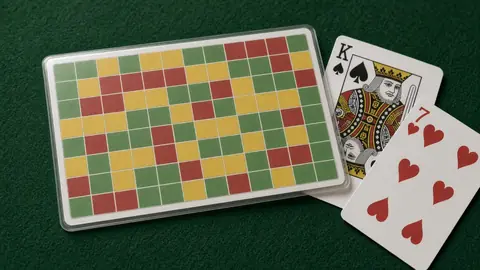 Basic strategy chartBasic strategy is the best possible play for every hand against every dealer upcard, for a given set of rules.
 Table rules and decksTwo blackjack tables can look identical and have very different odds.
 Vegas Strip and Atlantic CityVegas Strip, Atlantic City and Downtown are not different games, they are names for rule sets.
 Common mistakesMost of the money players lose to avoidable errors goes on a short list of habits.