Double Exposure blackjack: both dealer cards face up
In Double Exposure both dealer cards are visible from the start. It sounds like an easy win, but other rules change to compensate. This guide explains the trade-off and the rule differences that decide whether it is a good game.
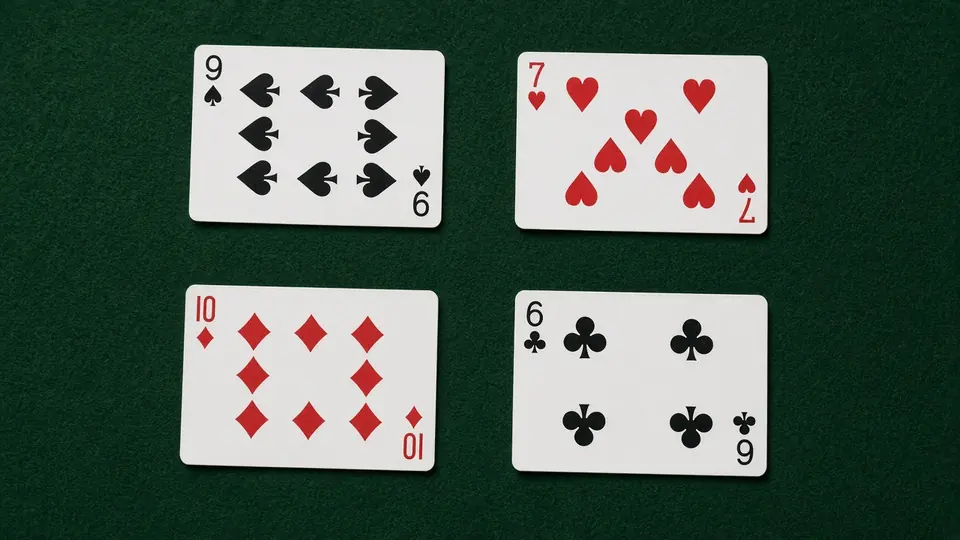
In brief
You see both dealer cards, but the dealer wins ties (except a tied blackjack, in the usual version) and blackjack pays only 1 to 1. Published house edges range from about 0.26% to 1.47% depending on the exact rules.
The core idea
In Double Exposure, both of the dealer's cards are dealt face up. You make every decision knowing exactly what the dealer holds. That is a big advantage, so the game takes it back in other ways. According to the Wizard of Odds:
- The dealer wins on all ties, except a natural blackjack tie.
- A player blackjack pays even money, 1 to 1, rather than 3 to 2.
- The player may split only once.
Other rules vary by table. Dealers may hit or stand on soft 17, tied blackjacks may be a push or a win for the player, and you may or may not be able to double after a split, or double on any first two cards.
How the rules change the edge
The same source gives the effect of some variations on the player's return:
| Rule | Effect |
|---|---|
| Dealer stands on soft 17 | +0.39% |
| Double after split allowed | +0.32% |
| Tied blackjack is a player win | +0.22% |
| Only one split | −0.71% compared with unlimited |
| Doubling limited to 9 to 11 | −1.04% |
| Doubling limited to 10 to 11 | −1.44% |
Real examples published by that source range from a house edge of 0.26% for a generous rule set, to 1.47% for a poor one. An eight-deck game where the dealer stands on soft 17, doubling is on hard 9 to 11, you can double after a split and a tied blackjack wins was listed at 0.66%.
So the answer to "is it good?" is "it depends on the table's rules". It can be as good as ordinary blackjack, but it is very sensitive to details.
What changes in your play
Because you see the dealer's hole card, you stop guessing. The usual hit-or-stand reasoning is replaced by comparing your total against the dealer's actual total:
- If the dealer already has 17, 18, 19 or 20, you only need to beat that total, and you know exactly which hands are worth drawing to.
- If the dealer has a stiff total such as 12 to 16, the dealer must draw, and you can choose to stand on a low total and let the dealer bust.
- Because ties go to the dealer, a hand equal to the dealer's total is as good as a loss. That makes hitting more attractive in some spots.
Strategy charts for Double Exposure exist for the common rule sets. Use one that matches the table you are playing, because the correct play depends on whether you can double after splitting and on how the dealer treats soft 17.
A quick comparison with ordinary blackjack
| Feature | Standard | Double Exposure |
|---|---|---|
| Dealer cards | One face up, one face down | Both face up |
| Blackjack pays | 3 to 2 | 1 to 1 |
| Ties | Push | Dealer wins |
| Splitting | Often several | Usually once |
Checking whether a table is worth it
- Read the rules screen. If you cannot find the tie rule, assume the dealer wins ties.
- Look for dealer standing on soft 17, doubling after split and doubling on any two cards.
- Check that a tied blackjack pushes or wins for you.
- If several of those are missing, the game has a much higher edge than standard blackjack.
Quick answers
Is Double Exposure easier to win?
You have more information, but the rules take back most of the advantage. It is not an easier way to make money.
Why does blackjack pay only 1 to 1?
It is one of the changes that compensates for seeing both dealer cards.
Is the game common online?
It is available at some sites. Check the rules, since they differ.
Keep reading
 Table rules and decksTwo blackjack tables can look identical and have very different odds.
 Doubling downDoubling down means doubling your bet in return for exactly one more card.
 Basic strategy chartBasic strategy is the best possible play for every hand against every dealer upcard, for a given set of rules.
 House edge explainedThe house edge is the average share of each bet the casino expects to keep over the long run.