The history of blackjack, from vingt-et-un to online tables
Blackjack has been played for over four hundred years. This is the story of how a card game from southern Europe became a British and American staple, how mathematicians solved it, and how the game reached the screen.
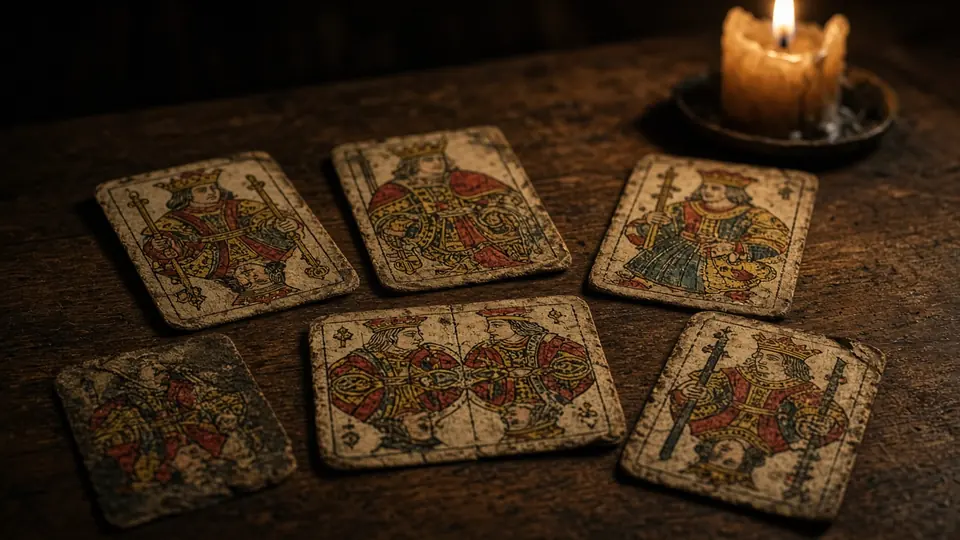
In brief
The earliest written mention is Cervantes around 1601 to 1602. The game became vingt-un in Britain, "blackjack" in North America, and was mathematically solved in 1956.
A Spanish card game
The earliest written reference to a game like blackjack comes from Miguel de Cervantes. In "Rinconete y Cortadillo", a story from his Novelas Ejemplares written between 1601 and 1602, two card cheats in Seville are proficient at a game called veintiuno, "twenty-one". The characters state that the aim is to reach 21 points without going over and that the ace counts as 1 or 11. It was played with the Spanish baraja deck, which has no tens. That suggests veintiuno was played in Castile by the early 17th century at the latest.
Vingt-un in Britain
Later records show the game across Europe. Twenty-one is recorded in Britain in the 1770s and 1780s, and the first published English rules appeared in 1800 under the name vingt-un. The word is French for twenty-one, and the British game that grew from it, Pontoon, takes its name from the same source.
Crossing the Atlantic
Vingt-un reached the United States in the early 1800s. The first American rules were a reprint of the 1800 English rules in 1825. In America the game developed in its own right, and around 1899 it was renamed "blackjack".
Where the name came from
A popular story says early gambling houses paid a 10 to 1 bonus if a player held the ace of spades with a black jack, and the name stuck after the bonus was withdrawn. Depaulis found no historical evidence of that bonus. His research suggests that prospectors in the Klondike Gold Rush (1896 to 1899) gave the name "blackjack" to American vingt-un, and that the bonus was simply an ace with any ten-value card. "Blackjack" is also a mineral, zincblende, found alongside gold and silver deposits, which may be the origin of the name. This is a theory, but a better supported one than the ace of spades story.
The mathematicians arrive
In September 1956, four American mathematicians and engineers, Roger Baldwin, Wilbert Cantey, Herbert Maisel and James McDermott, published a paper titled "The Optimum Strategy in Blackjack" in the Journal of the American Statistical Association. It was the first mathematically sound optimal strategy for the game, worked out by hand and with desk calculators. It became the foundation of everything that followed, including the basic strategy chart.
Edward O. Thorp, a mathematician, used the hand calculations of Baldwin to verify the basic strategy and then went further. His 1962 book Beat the Dealer showed that the casino's advantage could be overcome by counting cards. The system in that book, the ten-count, was later replaced by easier systems such as Hi-Lo. Casinos responded with countermeasures, such as dealing fewer cards before reshuffling.
Teams, and the casino response
Card counting became a team activity in the 1970s and 1980s. Ken Uston wrote about big-player teams. The MIT Blackjack Team and its successors operated from 1979 into the early 21st century. Stories of these teams later reached a wide audience through books and films. Counting remains a niche skill that requires training, discipline and capital, and it does not work against a game that is reshuffled every hand, which describes most RNG tables.
Blackjack online and in Britain
Online blackjack followed the growth of the web. In Great Britain the Gambling Act 2005 created the regulatory framework. The Gambling Commission was established under that Act, which came fully into force on 1 September 2007. From 1 November 2014 any operator offering remote gambling to customers in Great Britain, whether based here or overseas, has needed a Gambling Commission licence. That is why checking the licence matters, and the UK licence guide explains how.
What stayed the same
The core of the game is still what Cervantes described: reach 21 without going over, and treat the ace as 1 or 11. What changed is the arithmetic. Four centuries after veintiuno, the numbers are known precisely, and they say the house keeps a small edge. Understanding that is the best protection a player has, and the house edge guide lays it out.
Quick answers
Who invented blackjack?
Nobody knows. The earliest written mention is by Cervantes, but the game evolved from card games of southern Europe.
Is it true the name comes from the ace of spades and a black jack?
That story is popular, but historians have found no evidence for it.
When was basic strategy first worked out?
In 1956, in a paper by four American mathematicians and engineers, using desk calculators.
Keep reading
 Card countingCard counting is the one method that has ever been shown to beat blackjack, and it has a famous history.
 PontoonPontoon is the British version of twenty-one.
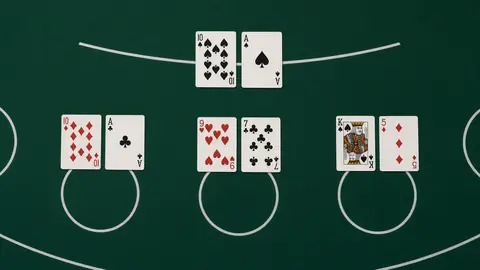 How blackjack worksBlackjack looks simple: get closer to 21 than the dealer without going over.
 House edge explainedThe house edge is the average share of each bet the casino expects to keep over the long run.